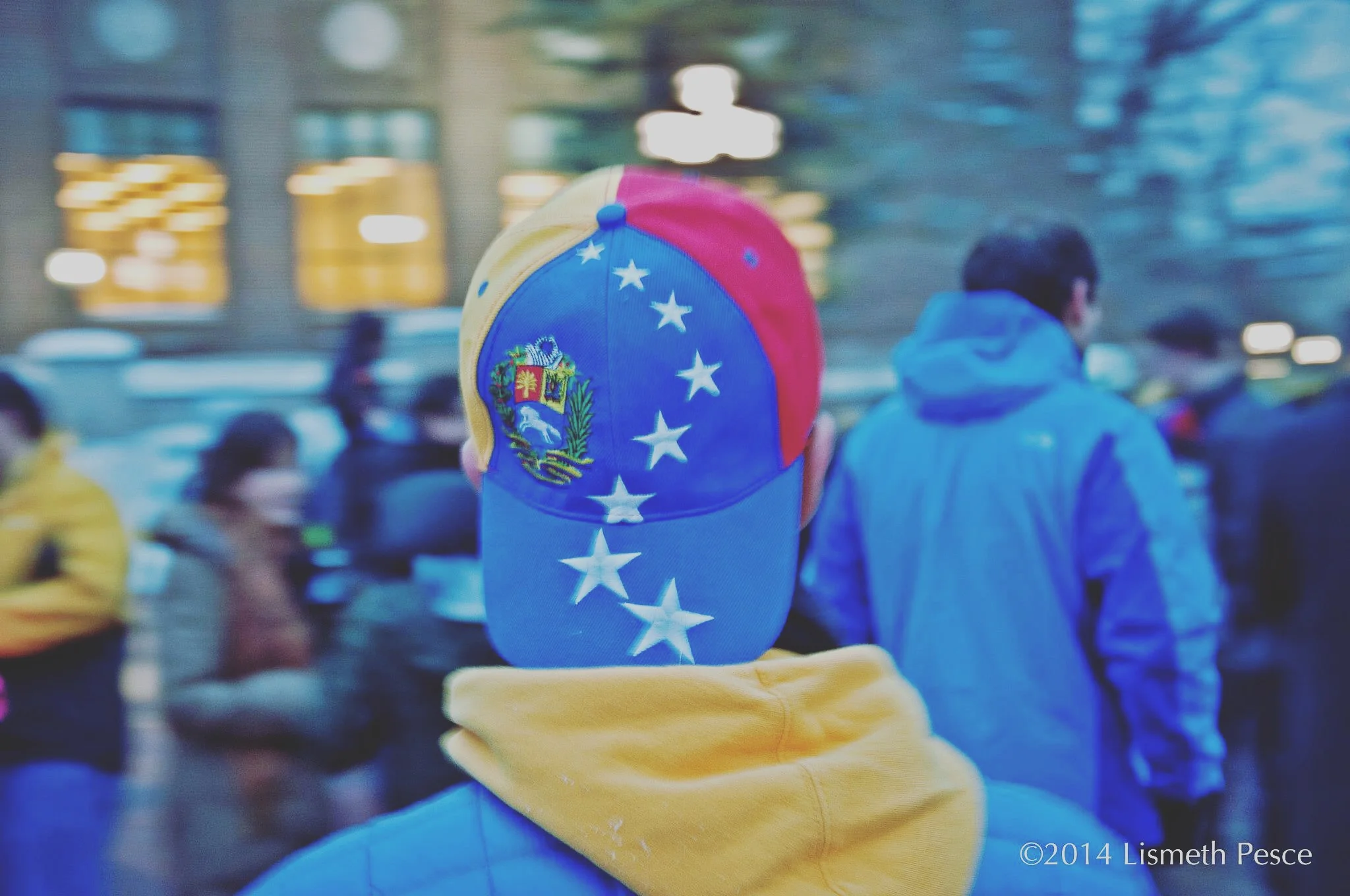
A Summary of the Growing Crisis in Venezuela
Venezuela is dying.
It has been since late 2013.
In the Spring of 2013, Venezuela broke into a political crisis with the death of Socialist President, Hugo Chavez. With his decease, came a series of distorted elections that manipulated the Venezuelan population into placing Nicolás Maduro as President. This defeat for the Opposition and its then leader, Henrique Capriles, prompted international demonstrations of Venezuelans around the world asking for United Nation involvement. The current policial crisis began with faulty elections where the government was caught using fake I.D.s to generate votes for Maduro, to a recurrent incarceration of Opposition political leaders.
As Henrique Capriles fell, a new leader, Leopoldo López rose and began to lead peaceful protests against the Venezuelan government. However, these riots were short lived for López, who was arrested in 2014 on accounts of treason. Lilian Tintori, López’s wife, began to lead the riots in his absence and since then has been able to have conferences with international powers such as the United States and Canada. In the summer of 2017, Leopoldo was released from the Ramo Verde prison and placed under house arrest as a political tactic from Maduro to calm the situation in the country. This act was too little too late though, for the country’s economic and social standing fell heavily during the last 3 years. Venezuelan opposition has become more active and united than ever before, but it has done so as a result of terrible circumstances. Unfortunately, Venezuela has become a victim to hyperinflation, rapidly increasing homicide rates and poverty, as well as national medicinal shortages.
With 2016 and 2017 being the years where Venezuelan protests have been the strongest, violent outbreaks began to erupt between the government and citizens. These confrontations have led to the death of Venezuelan youth. Due to reckless policing and control by the Guardia Nacional Bolivariana (GNB), also known as the National Venezuelan Guard, over 150 people have died in these protests since the Spring of 2016. Majority of the demonstrations take place in Caracas, Venezuela, the nation’s capital, which means that many of the people who take part in the riots are university students of the Universidad Central de Venezuela (UCV). The youth in Venezuela has experienced the national catastrophe firsthand and are asking for a political shift in order to give the country a chance to recover from the damage done by the Chavista party during the 2000s. The rallying of the people led to an increase in Opposition representatives in Venezuela’s National Assembly. Threatened by his decreasing approval rating, Maduro took this as a call to then nullify the Venezuelan National Assembly and declare executive powers to himself in order to pass legislation (without the opinion of the majorly Opposition assembly). With the assistance of the Cuban military, Maduro has become dictator of a country that was once rich due to petroleum trade. Now because of his ignorant policy making, he is the cause of its slow and inevitable collapse. Unless something changes.
Inflation rates in Venezuela have caused the national currency, the Bolívar, to lose it’s value by more than 99 percent (in comparison to USD) since 2010. This hyperinflation is also affecting the black market, which is the primary economic sector of Venezuela due to the corruption in Venezuela’s treasury. A lack in finances has caused supermarkets to ration merchandise, which has led to a national food and supply shortage in the country. Citizens of Venezuela can only go grocery shopping on certain days depending on the last couple numbers on their identification card in order to regulate the resources. Medicine in the country is nearly impossible to find, with many patients asking for Euthanasia injections because pain medicines, such as morphine, are completed depleted. This scarcity has also led to increasing rates of teen pregnancy because of the absence of contraception. Bachaqueros are people who have been illegally transporting necessary drugs into the country in order to assist those who are in desperate need of medical benefits.
The economic deprivation of the country is also to blame for the rising homicide rate in Venezuela. For every one hundred thousand people in the country, around 60 are murdered. Since there is an increase in poverty combined with a rise in the cost of living, people are resorting to theft, kidnapping, and homicide to survive. This trend is common all over the world in low-income countries, including El Salvador and Honduras. Even in the United States, cities such as Detroit experienced a rise in homicide and crime during the fall of the city with disruption of many American automobile companies (such as GM). The question that keeps arising to me is that if the country is showing so many signs of urgent assistance, why does Maduro decide to ignore them and proceed in the creation of a national divide that will ultimately lead Venezuela into the worst state it has been since the 1990s?
I was born in Caracas, Venezuela in 1997, the year that Hugo Chavez gained momentum in his rise to power. In the year 2000, my family and I moved to the United States after Chavez was inaugurated as President in 1999. Since then, I have observed the gradual decline of the Venezuelan community economically and the political upheaval from a safe distance. I regularly have to call my family in Caracas to ensure their safety. I would hear stories from my grandfather about how he was assaulted over a golden watch at a traffic light, and how motorcycle gangs began to terrorize many of the barrios that lay in the outskirts of the capital. To a person in the United States it’s very difficult to understand the situation because of how privileged we are to have an established democracy and a typically, stable economy. Since Venezuela has never had a secure political foundation, it has allowed for a power hungry Chavista movement to rise and become the present pandemonium that the country is experiencing. Chavez and his socialists created a mentality of equality with a mission to close the gap between the wealthy and the poor. Although admirable at first, Venezuela was never in an economic position to be able to succeed in helping the lower class through national welfare programs. Chavez did not comprehend this during his reign and now Nicolás Maduro, a completely incapable leader, is supposed to handle a situation that sparked from the Chavista program. Inadequate to be President, he is allowing the complaints of the people to go unheard. Through his unknowledgeable rhetoric, he has presented himself as a national disgrace to the country as well a tyrant who has silenced the National Assembly.
The worst part is that I can't do much about the situation except inform people in America about the suffering of the Venezuelan people. Last year I was able to donate medicine at a local Venezuelan restaurant in Santa Ana as well as help fund a Venezuelan protest group so that they could receive gas masks during the protests in Caracas and Maracaibo. The situation is not getting any better soon, and if no action is taken, the country will fall to a war, just like every nation that has needed a political change from a fascist government. Furthermore, the Opposition also needs to solidify a plan to implement into a new system in order to receive support from current government officials and international powers. On that note, I ask that international intervention be more closely considered by the United Nations in order to protect the Human Rights of the Venezuelan community and prevent a conflict that will have an impact on other nations as well.
Sources used and strongly recommended:
Kew, Ben. (2017, November). Socialism: Venezuela’s Minimum Wage Crashes to Under 4 Dollars a Month. http://www.breitbart.com/national-security/2017/11/10/socialism-venezuela-minimum-wage-crashes-to-under-four-dollars-per-month/
Garzon, Juan Carlos and Muggah, Robert. (2017, March). Venezuela’s raging homicide epidemic is going unrecorded. http://beta.latimes.com/opinion/op-ed/la-oe-garzon-muggah-venezuela-violent-crime-statistics-20170331-story.html
The Associated Press. (2017, November) Venezuela unveils largest-ever bill, worth a few US dollars. http://www.sanluisobispo.com/news/business/article182209321.html
Crooks, Nathan. (2017, November) Why Venezuela’s Sliding Towards Dictatorship, Default: Quicktake. https://www.washingtonpost.com/business/why-venezuelas-sliding-toward-dictatorship-default-quicktake/2017/11/06/8c377898-c32e-11e7-9922-4151f5ca6168_story.html?utm_term=.4292b008185b